How to Do SEO for Hotels: A Step-by-Step Guide

Hotel SEO is not general SEO with a hospitality coat of paint. It requires a specific approach to keyword research, content architecture, and technical setup that accounts for how OTAs dominate search results and where they leave gaps.
The short answer to “how to do SEO for hotels” is this: target the searches OTAs cannot win. Build content around traveler intent at the point of decision, not at the point of inspiration. Fix the technical issues that stop your site from being indexed properly. Then add schema markup so Google and AI search tools understand exactly what your property offers.
This guide walks through each step in the order you should execute it.
Step 1: Technical Audit

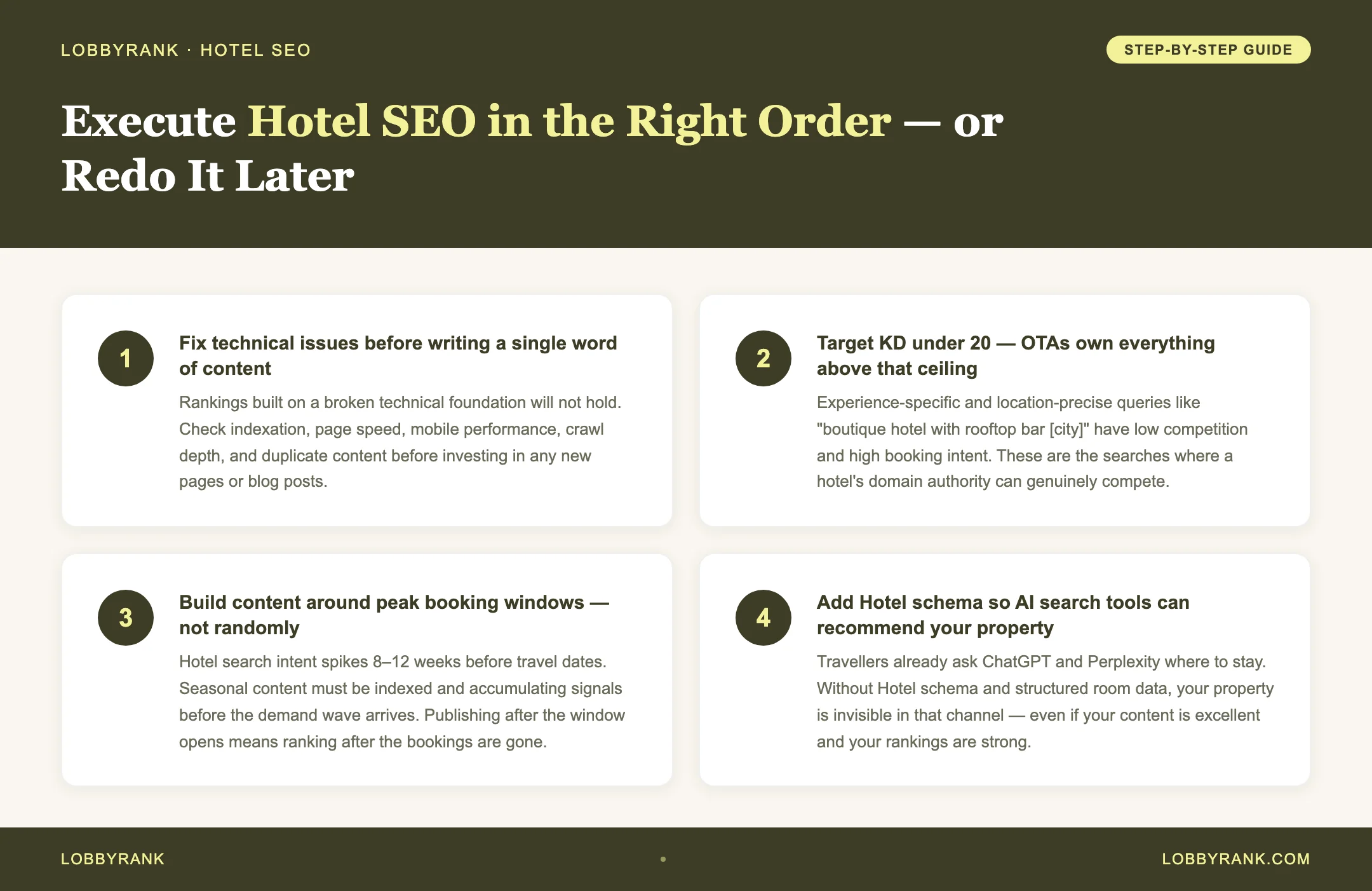
Before you write a single word of content, find out whether Google can read your site properly. Technical problems are the most common reason hotel websites fail to rank despite having decent content.
Run a crawl of your site using a tool like Screaming Frog, Sitebulb, or Google Search Console. You are looking for:
Indexing issues. Pages blocked by robots.txt or noindex tags. This happens when developers exclude staging environments and accidentally deploy the same settings to production. In Google Search Console, check Coverage for excluded pages.
Page speed. Hotel sites often carry large image files from professional photography. Images should be compressed and served in WebP format. On mobile, your pages should load in under 3 seconds. A 5-second load on mobile costs you bookings before the guest even reads the headline.
Mobile performance. More than 60% of hotel searches happen on mobile. If your site is not fully responsive with readable text and tap-friendly booking buttons, Google will rank it below competitors that are.
Crawl depth. Your individual property pages should be reachable within 3 clicks from the homepage. If your navigation buries property detail pages, Google crawls them less frequently.
Duplicate content. Many hotel sites have thin or duplicated location pages across properties. Google may choose not to index all of them. Each property page needs unique content: property-specific descriptions, local area context, and booking intent copy that could not appear on any other property page.
Fix the critical technical issues before moving to keyword research. Rankings built on a broken technical foundation will not hold.
Step 2: Keyword Research for Booking Intent
This is where hotel SEO diverges most sharply from general SEO practice.
OTAs own the broad search terms. “Hotels in Edinburgh,” “best hotels London,” “cheap hotels Barcelona” are dominated by Booking.com, Expedia, and Google’s own Hotel Ads widget. Targeting these terms directly is a budget you do not have competing against infrastructure you cannot match.
The opportunity is in long-tail, experience-specific, and location-precise queries. These are the searches travelers make when they know what they want and they are ready to book. OTAs rarely rank for them because their pages are generic by design.
Examples of the keyword types that work for hotel SEO:
- “Boutique hotel with rooftop bar [city]”
- “Pet-friendly hotel near [landmark or attraction]”
- “Hotel with direct beach access [region]”
- “Extended stay hotel [city] [neighborhood]”
- “Business hotel with gym [city]”
- “Romantic weekend hotel [nearby city or region]”
These terms have lower search volume than broad keywords. But the intent is different. A guest searching “boutique hotel lower east side Manhattan” has already decided on a neighborhood. They are comparison-shopping between specific properties, not choosing a city. Converting that guest direct is far more achievable than competing for “hotels in New York.”
For primary keywords, target KD (keyword difficulty) under 20. For your content cluster, you can expand to KD 30-35. This keeps you in terrain where your domain authority can compete without requiring the years of link-building that broad keywords demand.
Map your keyword targets to your properties. A coastal resort needs different keywords than a city business hotel. Do not use a one-size-fits-all keyword list across a multi-property group.
See our pillar guide to hotel SEO for a deeper breakdown of the keyword selection process for hotel groups.
Step 3: Content Strategy
Your content strategy has two components: property pages and a content cluster.
Property pages first. Each property needs a standalone SEO page optimized for its primary keyword. That keyword should appear in the H1, the first paragraph, the meta title, and at least two subheadings. The page should include: property-specific copy (not templated from other properties), local area content that helps Google understand geographic context, and clear booking CTAs that link directly to the property’s booking engine.
Do not use the same template copy across all property pages. Google identifies this as thin content and deprioritizes all pages with the same pattern.
Content cluster second. A content cluster is a set of supporting blog posts that build topical authority around your primary keyword. If your primary keyword is “boutique hotel Edinburgh,” your cluster might include:
- “Things to do near [your Edinburgh property] this weekend”
- “Where to stay in Edinburgh for New Year’s: a guest’s guide”
- “Business travel to Edinburgh: what to know before you book”
- “Pet-friendly Edinburgh: hotels, parks, and what to pack”
Each cluster post targets a long-tail variant of your core theme. Together they signal to Google that your site is a genuine authority on hospitality in that location. This lifts the ranking of your primary property page alongside the cluster pages.
Build content around peak booking windows, not randomly. For a Scottish property, content about New Year’s (Hogmanay) should publish in October. Summer leisure content should publish in March. Hotel search intent spikes 8-12 weeks before the travel date. Your content needs to be indexed and accumulating signals before the demand arrives.
Step 4: Schema Markup
Schema markup is structured data that tells Google and AI search tools exactly what your page is about. For hotels, it directly impacts how your property appears in search results and whether AI tools like ChatGPT or Perplexity recommend your property.
The most important schema types for hotel websites:
Hotel schema. Markup your property pages with Hotel type from Schema.org. Include: property name, address, telephone, geo coordinates, price range, check-in and check-out times, amenities, and star rating.
Offer schema. For properties with direct booking, marking up room types with Accommodation and Offer schema helps Google understand what you are selling and at what rate.
FAQ schema. Add FAQ schema to any page with a frequently asked questions section. This increases your chances of appearing in Google’s featured snippets and AI-generated answers.
LocalBusiness schema. For multi-property groups, each property page should have LocalBusiness markup in addition to Hotel markup, with a unique address and phone number per location.
Test your schema implementation using Google’s Rich Results Test tool. Errors in schema markup prevent it from being read, so check after every implementation change.
AI search tools like Perplexity and ChatGPT increasingly cite well-structured, schema-marked pages in their hotel recommendations. This is not future-looking. It is happening now. Guests are already asking AI tools where to stay. If your pages lack schema, you are invisible in that channel.
Step 5: Monitor and Adjust
Hotel SEO is not a one-time setup. Rankings move, search intent shifts seasonally, and competitors adjust their strategies. Monthly monitoring is the minimum standard.
Track in Google Search Console. Monitor which queries are driving impressions and clicks to your property pages. Look for queries you are appearing for but not ranking highly on. These are your best targets for on-page optimization.
Track direct booking attribution. Set up goal tracking in Google Analytics 4 for direct bookings completed through your own booking engine. Segment by organic traffic source. This is the metric that connects SEO work to ADR impact. If organic traffic is growing but direct booking rate is flat, something in the booking flow is converting poorly. That is a different problem to fix.
Review content performance quarterly. Which cluster posts are ranking? Which are not? Posts ranking on page 2 for target keywords benefit from a content refresh: adding updated data, answering additional related questions, and improving internal linking from the primary property page to the cluster post.
Update for peak windows. Each year, update seasonal content before the demand window opens. A post about summer stays at a coastal property should be refreshed every February with current pricing, updated amenities, and new local area content. Freshness signals matter in competitive hospitality search.
Working with a Specialist
Executing this process well takes time. For a multi-property hotel group, the technical audit alone can surface dozens of issues across property pages, booking engine integrations, and local listing accuracy. The content requirement is ongoing. Schema implementation needs maintenance as Google updates its supported types.
For hotel marketing directors managing distribution, rates, and guest experience simultaneously, handing the SEO execution to a specialist is often the right decision. Not because hotel SEO is impossible to learn, but because the compounding effect of doing it consistently over 12 months requires dedicated capacity.
LobbyRank is built for multi-property hotel groups that need hospitality-native SEO at a price point that makes sense against OTA commission savings. Our technical SEO service for hotels covers the full audit, implementation, and ongoing monitoring described in this guide.
At $750/month, the retainer pays for itself when direct bookings shift by even a small margin. One additional direct booking per week at an ADR of $200 covers the entire monthly cost.
Direct bookings start with search. This is the process that gets you there.
Camilla Gleditsch has led marketing and communications across Asia and Europe for 11+ years, including regional agency communications at BBDO across nine markets. She now runs a portfolio of specialized SEO businesses, each serving a single vertical with deep expertise and full-service infrastructure.