Hotel Resort SEO Services: What Should Be Included

Hotel resort SEO services exist in a category of their own. Resorts are not just hotels with more rooms. They are destination experiences. The searches that drive bookings are different, the content that converts is different, and the technical requirements have their own distinct demands.
A retainer that works for a city-centre business hotel will underdeliver for a coastal resort. This post covers what a well-structured hotel resort SEO service should include, where resorts diverge from standard hotel SEO, and what a monthly engagement actually looks like.
Why Resort SEO Is Different

A city hotel competes on location and rate. A resort competes on experience. That distinction changes everything about keyword strategy and content architecture.
City hotel searches: “hotels near Manchester Piccadilly,” “business hotel Birmingham city centre,” “hotel with parking Leeds.”
Resort searches: “spa weekend Cotswolds,” “family resort Cornwall beach,” “romantic hotel with hot tub Peak District,” “adults-only resort Scotland.”
These are experience-led, destination-led, and intention-led searches. OTA sites struggle to rank for them at scale. A well-built resort content strategy can own these terms organically, converting browsers at higher ADR than OTA-sourced bookings because the guest already knows what they want before they arrive.
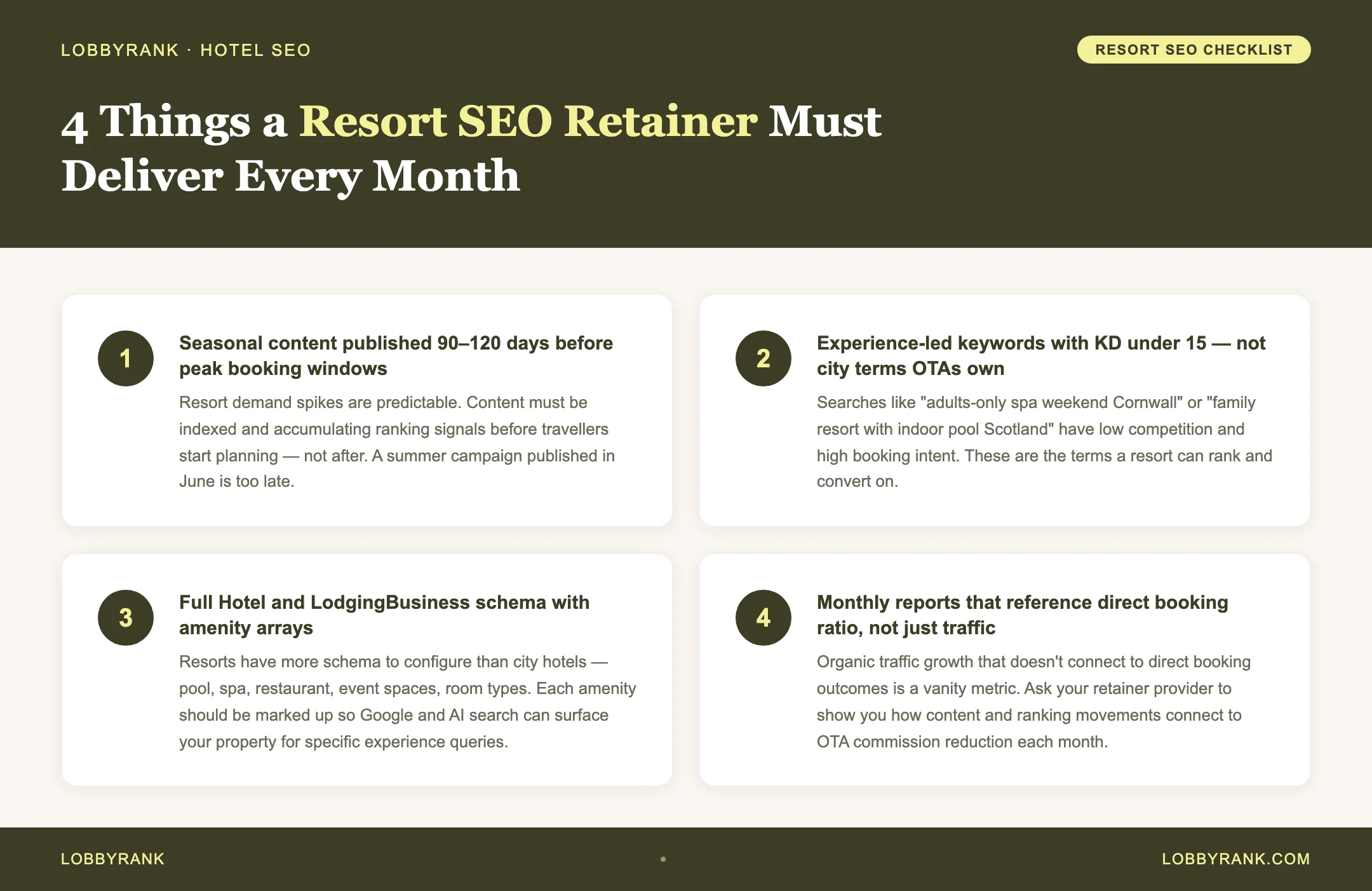
Resort SEO also has to account for demand seasonality in a way that most hotel SEO does not. A summer coastal resort and a winter ski lodge face entirely different keyword demand curves. Content must be built 90 to 120 days ahead of peak intent windows to appear in search results when travellers are actually planning and booking.
What Hotel Resort SEO Services Should Include
1. Technical audit
Before anything else, the site needs to be technically sound. Google cannot rank pages it cannot crawl and index. A full technical audit covers:
- Site speed and Core Web Vitals (particularly for image-heavy resort sites)
- Mobile performance (the majority of leisure travel searches happen on mobile)
- Crawlability and indexation (no orphaned pages, no blocked assets)
- Internal linking structure (does Google understand which pages are most important?)
- Redirect health (no chains, no broken links)
Resort websites tend to accumulate technical issues over time: slow-loading photography galleries, duplicate content across property pages, seasonal pages that get removed and re-added without canonical tags. A technical audit surfaces and fixes all of this.
2. Keyword research targeting booking intent
Generic keyword research fails resorts. The strategy must separate four distinct search types:
- Brand searches: guests who already know the property
- Location searches: “spa hotels Devon” (broad intent, top-of-funnel)
- Experience searches: “wellness retreat adults only” (mid-funnel, high intent)
- Decision searches: “best spa resort Yorkshire reviews” (bottom-of-funnel, ready to book)
A proper resort keyword strategy builds content across all four layers. Bottom-of-funnel experience searches often have low keyword difficulty and high direct booking conversion. OTA sites rarely target them well because their content is generated at scale and cannot match the specificity of a purpose-built resort page.
3. Seasonal content production
This is where most hotel SEO retainers underdeliver for resorts. Generic “hotel near X” content does not capture the experience-driven demand that resort guests generate.
Monthly content production should include:
- Seasonal experience pages built 90-120 days ahead of peak booking windows
- Blog posts targeting specific experience queries (“what to pack for a spa weekend,” “best time to visit for walking holidays”)
- Package-specific landing pages optimized for the exact searches guests use to find those packages
- AEO-optimized content so your resort appears when travellers ask AI tools where to go
The KD for experience-led resort searches is often below 15. These are not contested terms. They require consistent content production, not a one-time effort.
4. Schema markup
Resorts benefit from structured data that goes beyond basic hotel schema. A complete schema implementation includes:
Hotelschema with amenity details, room types, price range, and check-in/check-out informationFAQPageschema on key landing pages (directly feeds AI Overviews and voice search)ReviewandAggregateRatingschema (if reviews are hosted on-site)BreadcrumbListschema for multi-property or multi-experience site structuresEventschema for seasonal packages or on-property events
Schema markup does not directly improve organic rankings but it does improve click-through rates and AEO visibility. For resorts, it is not optional.
5. OTA counter-strategy
OTAs dominate broad search terms. They cannot compete on specificity. The role of resort SEO is to build a presence on the long-tail experience searches where OTAs have no content.
A guest who finds your resort by searching “adults-only coastal spa weekend Cornwall” and lands directly on your booking engine is worth significantly more than a guest who finds you on Booking.com and pays 18-25% commission on the rate.
A good hotel resort SEO service maps the OTA landscape for your key terms and identifies where they rank, where they do not, and which gaps your content can own. That analysis should inform every content decision.
6. Monthly reporting
Every month, you should receive:
- Ranking movement for tracked keywords (grouped by intent tier)
- Organic traffic and direct booking attribution
- Content published and what it targets
- Technical issues found and resolved
- Next month’s content plan
The metrics that matter are direct booking traffic growth and direct booking ratio improvement. OTA commission savings are the financial outcome. A good retainer connects those dots every month.
What a Monthly Retainer Covers
A full hotel resort SEO retainer at LobbyRank includes technical audit (month one), ongoing technical monitoring, keyword research and content planning, monthly content production (four to six pieces per month), schema implementation, AEO optimization, and monthly performance reporting.
The Tier-Grow retainer is $750/month for established resort websites (12+ months old, existing domain authority). The Tier-Build retainer is $1,200/month for new resort websites under six months old. Both include the same deliverables. The difference reflects the additional authority-building work required for newer domains.
For more on how the content strategy element works, see our guide to hotel content strategy.
Who Needs a Resort SEO Retainer
The model works best for independent resorts and small groups (two to ten properties) where OTA dependency is a recognized business problem. If your direct booking ratio is below 40%, SEO is almost certainly the most cost-effective lever available.
A single direct booking that would have carried a 20% OTA commission pays for a month of the retainer. The math is straightforward.
For a full breakdown of how hotel SEO works across property types, read our hotel SEO company guide.
If you want to understand whether LobbyRank is the right fit for your properties, the process starts with a brief conversation. No commitment required.

Camilla Gleditsch has led marketing and communications across Asia and Europe for 11+ years, including regional agency communications at BBDO across nine markets. She now runs a portfolio of specialized SEO businesses, each serving a single vertical with deep expertise and full-service infrastructure.