Best Hotel SEO Companies in 2026: What to Look For

OTA commissions average 18-25%. On a $10M revenue hotel group, that is $1.8M to $2.5M leaving the business every year. Most of it goes to Booking.com and Expedia because those platforms outrank your hotel’s website on Google for every high-value booking keyword.
The right hotel SEO company changes that. Not by out-spending the OTAs on broad keywords they own. By targeting the search queries OTAs cannot compete on: experience-specific, location-specific, and long-tail booking intent terms that drive direct reservations.
This guide covers what separates a good hotel SEO company from a generalist agency that happens to have a hospitality client. Use it to evaluate whoever you are talking to.
What Makes a Hotel SEO Company Good

The answer is not a long client list or a large team. It is specialization.
Hotels have a specific SEO challenge that generalist agencies consistently fail to solve. OTAs hold domain authority scores in the 90s, backed by billions in marketing spend and thousands of content writers. You cannot beat them on “hotels in New York.” You can beat them on “boutique hotel lower east side with rooftop bar” — a query where the traveler is ready to book, and OTA listings do not rank.
A good hotel SEO company understands this. They build their keyword strategy around traveler intent at the point of decision, not around vanity traffic. They know the difference between a guest searching to explore and a guest searching to book.
They also speak in your numbers. ADR, RevPAR, direct booking ratio, channel mix. Not “traffic” and “impressions.”
5 Criteria to Evaluate Any Hotel SEO Company
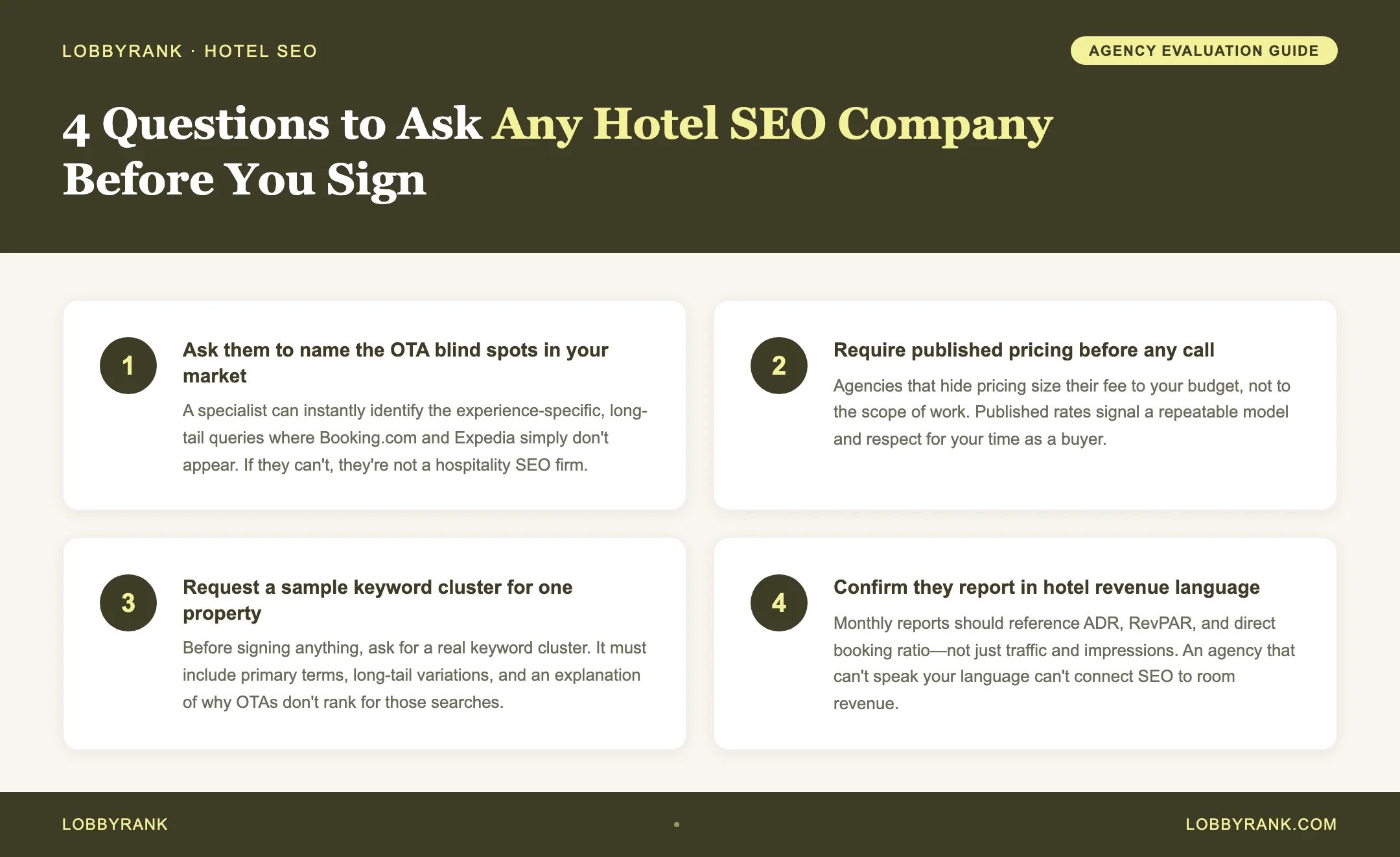
1. Do they understand OTA keyword dynamics?
Ask them this question directly: “Which keywords are OTAs unable to compete on for my market?”
A generalist agency will not have a good answer. A specialist will walk you through experience-specific and long-tail queries where OTA pages simply do not appear. Searches like “pet-friendly hotel near [landmark]” or “hotel with spa and direct beach access [region]” are where hotel SEO wins.
If they cannot explain the OTA blind spot in search, they cannot build a strategy around it.
2. Do they publish pricing?
If you have to request a proposal to find out what it costs, that is a red flag. Specialist hotel SEO companies with a clear, repeatable model publish their pricing. You should not need a call to get a number.
This matters beyond transparency. Agencies that hide pricing often size their fee to your budget, not to the scope of work. Published pricing signals confidence in their model and respect for your time.
3. Can they show a keyword strategy specific to your properties?
Before you sign anything, ask for a sample keyword cluster for one of your properties. It should include primary keywords, long-tail variations, and a clear note on why OTAs do not rank for those terms.
If they give you a list of broad keywords with high search volume and high keyword difficulty, they are targeting the wrong searches. The right hotel SEO strategy targets high-intent keywords with KD under 20 in your specific market. Those are the terms where you can rank, and where the guests converting are genuinely ready to book direct.
4. Do they include seasonal demand planning?
Hotel search is not flat. Summer coastal properties see demand spikes in March and April as guests plan ahead. Ski resorts peak in October. Business travel corridors shift around conference seasons.
A strong hotel SEO company builds content clusters that anticipate these windows, not react to them. Ask how they approach seasonal keyword timing. If the answer is vague, the content you receive will be generic and off-cycle.
5. Do they deliver results in hotel revenue terms?
Monthly reports from a hotel SEO company should show ranking movements, organic traffic changes, and direct booking attribution where possible. Not just impressions.
More importantly, they should frame progress against your direct booking ratio and OTA commission displacement. A report that shows you ranked for a new keyword cluster but does not connect it to booking data is not a hospitality SEO report. It is a traffic report dressed up as one.
Read our full guide to evaluating a hotel SEO partner for a deeper breakdown of what to expect from a specialist agency.
What Hotel SEO Should Cost in 2026
The market splits into three tiers:
Generalist agencies with hotel clients: $1,500-$4,000/month. Broad SEO scope, no hospitality specialization. Reports focus on traffic and rankings, rarely on direct booking impact. These are the agencies most hotel marketing directors have already tried.
Hospitality marketing specialists: $4,000-$10,000/month. Deep industry knowledge, dedicated hotel content writers, strong case studies. Appropriate for large branded hotel groups or luxury independents with marketing budgets above $150K/year.
Automation-first hotel SEO specialists: $750-$1,200/month. Narrower scope than full-service hospitality agencies, but designed specifically for multi-property independent groups where the OTA commission problem is most acute. LobbyRank sits in this tier. Our model runs on AI workflows rather than large teams, which keeps monthly retainer costs accessible without reducing deliverable quality.
The pricing comparison that matters most is not agency A versus agency B. It is the SEO retainer versus what you are paying in OTA commissions on the bookings you are losing to direct.
At $750/month, recovering four additional direct bookings per month at an ADR of $200 covers the entire retainer. For most hotel groups doing over $3M in OTA-driven annual revenue, that is a realistic break-even point inside the first 90 days.
Red Flags to Watch For
Guaranteed rankings. No legitimate SEO company guarantees a specific position. Anyone who does is either targeting keywords so easy they have no commercial value, or lying.
No hotel industry language in their materials. If their website does not mention OTA commissions, RevPAR, direct booking ratio, or traveler search intent, they are not a hotel SEO specialist. They are a generalist agency who added a hotel page to their site.
Traffic metrics without booking context. An agency that measures success purely in sessions and clicks does not understand how hotel revenue works. Ask them upfront: “How do you connect SEO work to direct booking outcomes?”
Long minimum contracts. A 12-month lock-in is not standard in a specialist market that delivers results in 60-90 days on low-competition keywords. Month-to-month or 90-day minimum is the appropriate commitment window.
No case studies with booking data. A hotel SEO company should be able to show ranking improvements alongside traffic growth. Bonus points for direct booking lift data, even if approximate.
A Note on Choosing for Your Specific Property Type
The best hotel SEO company for a 15-property resort group is not necessarily the right fit for a boutique independent hotel collection with 4 properties. Consider scale, budget, and how tightly the agency’s keyword strategy maps to your guest profile.
Leisure-focused properties benefit most from experience and destination content clusters. Business travel properties benefit from corporate travel intent keywords and local proximity searches. A hotel SEO company worth working with will ask about your guest mix before recommending a content strategy.
If you are evaluating options, our hotel SEO consulting service includes an initial organic visibility scan for your properties before any commitment. It shows you where you rank today, which searches are sending guests to OTAs, and where the keyword opportunities are in your specific market.
Direct bookings start with search. The company you choose should understand both sides of that sentence.

Camilla Gleditsch has led marketing and communications across Asia and Europe for 11+ years, including regional agency communications at BBDO across nine markets. She now runs a portfolio of specialized SEO businesses, each serving a single vertical with deep expertise and full-service infrastructure.