The Hotel SEO Checklist: 21 Items That Drive Direct Bookings

Most independent hotels lose 15 to 25 percent of every booking to OTA commissions, and the room rate has been quietly inflated to absorb that cost. The painful part is that the guest who just booked through an OTA almost always searched for your property by name first. They saw the OTA result, clicked, and you paid the toll on a guest who was already yours. A clean hotel SEO checklist is how you close that gap. Below are 21 items, grouped into four categories, that move bookings from OTA channels back onto your own site.
This is not theory. It is the working hotel SEO checklist we run on independent hotels, boutiques, and resorts before we touch a single page. Read it as a document. Mark what you have. Mark what you do not. Then work the gaps in order.
Technical foundations (5 items)

If Google cannot read your site cleanly, nothing else matters. Technical work is unglamorous, and it is where most hotel sites quietly bleed visibility.
1. Site speed and mobile-first performance
Hotel sites tend to be heavy. Hero videos, retouched photography, parallax effects, booking engine scripts. Each one costs you load time, and load time costs bookings. Aim for Largest Contentful Paint under 2.5 seconds on a mid-range mobile device. Compress images, serve next-gen formats, and lazy-load anything below the fold.
2. Mobile usability
More than 60 percent of hotel discovery happens on mobile, and the booking conversion follows. Tap targets need to be at least 44 by 44 pixels. Date pickers must be one-handed friendly. If your mobile menu hides the booking CTA below three taps, fix that today.
3. Structured data for hotels (LodgingBusiness schema)
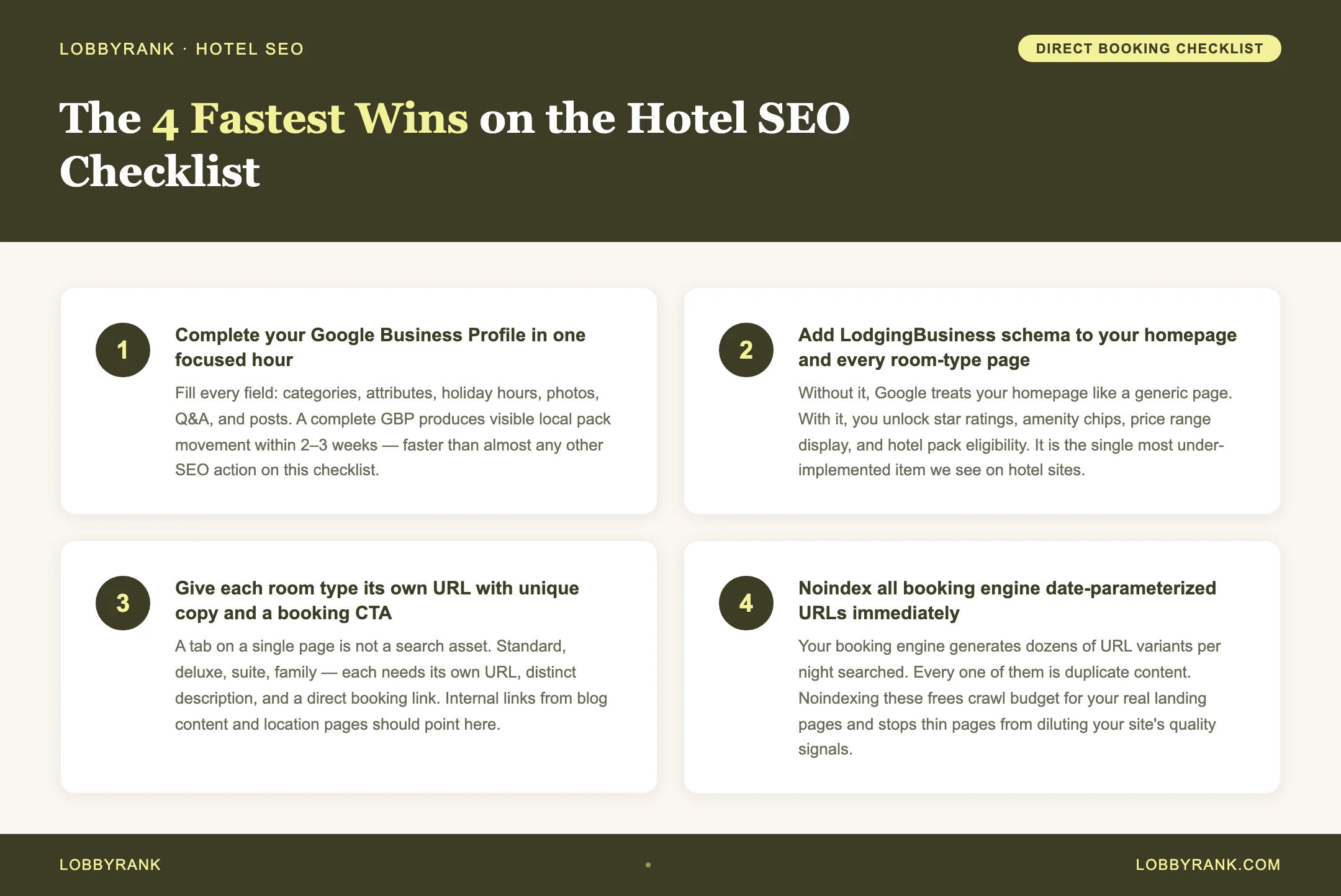
The single most under-implemented item we see. LodgingBusiness schema tells Google and AI search engines exactly what type of property you are, your room types, amenities, check-in times, star rating, and price range. Without it, Google treats your homepage like a generic page. With it, you become eligible for rich results and AI search citations.
4. Indexation of booking flow versus noindex of date-parameterized URLs
Your booking engine probably generates dozens of URL variants per night searched. These should almost always be noindex. Canonical room type pages and rate pages stay indexed. Dynamic checkout URLs do not. Get this wrong and Google wastes its crawl budget on duplicate junk while your real landing pages sit underindexed.
5. Faceted booking page handling
If guests can filter by room type, view, or amenity bundle, each filter combination produces a URL. Use canonical tags to point filtered URLs back to the parent page, or block crawl access via robots.txt for low-value combinations. One clean URL per searchable intent, not a thousand thin pages competing with each other.
On-page work (6 items)
On-page is where you turn search intent into a booking. Most hotel sites are weakest here because the agency that built the site treated it as a brochure rather than a search asset.
6. Location pages with local intent
Every neighborhood, district, or landmark near your property deserves its own page if travelers search for hotels there. “Hotels near [landmark]” or “Where to stay in [neighborhood]” can rank for the exact query a planning guest types. Include directions, walking distance to anchors, and one or two paragraphs of genuine local insight.
7. Room type pages with internal linking
Each room category needs its own page, not a tab on a single page. Standard, deluxe, suite, family, accessible. Each gets a unique URL, distinct copy, square footage, capacity, and a clear booking CTA. Link from your homepage, blog content, and location pages into the room types that match. Most hotel sites underweight internal links to the pages that actually convert.
8. Amenity pages
If you have a spa, restaurant, rooftop bar, kids club, or meeting space, each is a search asset. People search “hotels with [amenity] in [city]” constantly. A single amenity page with photos, hours, and what makes yours specific can rank for queries the booking engine never could.
9. FAQ blocks on key pages
Add an FAQ block to your homepage, every room type page, every location page, and every amenity page. Use real questions guests ask before booking. Parking, pet policy, breakfast, check-in, distance to airport. FAQ blocks feed AI search results and Google’s People Also Ask boxes directly. Treat them as ranking real estate.
10. Hero copy targeting buyer-intent queries
The headline on your homepage and key landing pages should answer the search query the guest just typed. If they searched “boutique hotel with rooftop bar in Lisbon,” your hero needs to say, in plain words, that you are exactly that. Generic taglines like “Where memories are made” do nothing for ranking and less for conversion.
11. Internal linking from blog posts to booking pages
Every blog post should contain at least two contextual links to a relevant room type page, amenity page, or the booking engine. If you wrote a guide to a local festival, link to your nearest room types. Link equity flows downhill, and the booking page is the bottom of the hill.
Content (5 items)
Content earns the long tail. The keywords OTAs cannot afford to chase, the queries that signal planning intent, and the copy that tells Google to trust you as the local expert.
12. Local guides for area attractions
Write the definitive local guide for the things travelers do near your property. Not a top-ten list scraped from elsewhere. Best coffee within a ten-minute walk. Where locals eat on Tuesday nights. These pages rank for queries that bring high-intent travelers, and they earn backlinks naturally because they are genuinely useful.
13. Seasonal posts
Hotel demand is seasonal, and search demand follows. Publish on a calendar that lines up with your booking patterns. “Summer in [region]” three months before summer. “Christmas markets near [city]” in late September. Lead time matters because rankings take weeks to build, and you want them firm by the time travelers start planning.
14. FAQ-targeted blog content
Beyond FAQ blocks on service pages, write standalone posts that answer single high-volume questions in depth. “How far is [airport] from [city center].” “Is [neighborhood] safe at night.” Each post targets one question, answers it clearly in the first paragraph, and links back to a relevant booking page.
15. Comparison content
Travelers compare. Help them compare on your terms. “Boutique versus chain hotels in [city].” “Where to stay in [neighborhood A] versus [neighborhood B].” Comparison content earns featured snippets and AI citations because it answers a clear decision question with structured information.
16. Event and conference targeting
If your city hosts a recurring conference, festival, or event, write a page for it. “Where to stay during [event] in [city].” Include distance to the venue, event rates if any, and logistical detail repeat attendees would want. These pages rank for narrow but high-converting queries OTAs rarely bother with.
Off-page (5 items)
Off-page tells Google and AI search engines the world considers you legitimate. Most independent hotels stop too early here.
17. Google Business Profile completeness
Fill every field. Categories, attributes, hours, holiday hours, photos, products, services, Q&A, posts. A complete profile is one of the highest-leverage hours of work in the entire hotel SEO checklist. Add new photos monthly, answer Q&A yourself, reply to reviews within a few days. Local pack visibility responds to this faster than almost anything else.
18. Local citations with consistent NAP
Your Name, Address, and Phone number must be identical across every directory you appear in. Tourism boards, chambers of commerce, regional travel sites, hotel directories. Inconsistent NAP data softens Google’s confidence in your location. Audit yearly, fix as needed.
19. Hotel directory listings
Beyond OTAs, there is a long tail of legitimate hotel directories that pass relevance signals. Niche directories for boutique properties, sustainable hotels, design hotels, family-friendly hotels, regional tourism portals. Get listed everywhere your property genuinely fits. Skip pay-to-play directories with no editorial standards.
20. Review schema with aggregate rating
If you display reviews on your site, mark them up with Review and AggregateRating schema. This makes star ratings eligible to appear in search results next to your listing. Pull reviews from your own database, booking engine, or Google. Real reviews only.
21. Partner backlinks from local restaurants and attractions
Your neighborhood is full of natural link partners. The restaurant where you send guests for dinner. The museum across the square. The wine tasting your concierge recommends. Swap recommendations on your respective websites, and the links follow. These are the highest-quality local links you can earn.
Working the list
Twenty-one items is a lot. The order matters less than the discipline of finishing what you start. We usually advise hotels to begin with the technical foundations because they unblock everything else, then move to Google Business Profile for the fastest payoff, then alternate between on-page and content work.
If this hotel SEO checklist feels overwhelming, here is the LobbyRank hotel SEO blueprint, which walks through the same 21 items with the deeper context and decision rules we use on real hotel engagements.

Camilla Gleditsch has led marketing and communications across Asia and Europe for 11+ years, including regional agency communications at BBDO across nine markets. She now runs a portfolio of specialized SEO businesses, each serving a single vertical with deep expertise and full-service infrastructure.