Hotel SEO Software vs Hotel SEO Agency: When You Actually Need Each
Hotel SEO software helps you do SEO. A hotel SEO agency does SEO for you. Both exist for a reason, and most hotel marketing directors we speak to are quietly evaluating one when they should be evaluating the other.
This is the honest version of that conversation. Real platforms, real pricing, real decision lines. Some readers will finish this and decide software is correct for them. That is the right outcome.
Software Helps You Do SEO. An Agency Does SEO For You.
The category split is simple, even if vendor marketing makes it confusing. Software gives you data and workflows. An agency gives you strategy, content production, and execution against a plan.
A direct-booking platform like Triptease will tell you which OTA is undercutting your rate today. A keyword tool like Ahrefs will tell you that “boutique hotel Reykjavik with spa” has a KD (keyword difficulty — the 0-100 score Ahrefs uses to estimate how hard a keyword is to rank for) of 11 and 320 monthly searches. A hotel SEO agency will write the 1,500-word page that ranks for it and link it into the rest of your site so Google understands what the property is about.
You need both layers eventually. The question is which one is the bottleneck right now.
The Hotel SEO Software Landscape in 2026
Hotel software with an SEO angle falls into three buckets. None of them does the full job alone, and that is fine — they were not designed to.
Direct-booking platforms with SEO-adjacent features. Triptease, Cendyn (which absorbed The Hotels Network in 2024), and Avvio sit here. Their core job is conversion on traffic you already have — price comparison, parity messaging, retargeting, abandoned-booking recovery. Triptease starts around $300/month for small properties and climbs into the four figures for multi-property groups. Avvio bundles SEO with its booking engine and is more common with European independents.
These platforms move the needle on conversion rate, not on search visibility. If your problem is that travelers find your site and leave, this is the right category. If your problem is that travelers never find your site at all, it is not.
Hotel-specific intelligence platforms. Lighthouse (formerly OTA Insight) and Demand Calendar dominate this layer. Lighthouse is closer to a revenue management and parity-tracking tool than an SEO tool, but its rate and parity data is what most modern hotel SEO content needs to be useful. Pricing typically runs $500 to $2,000 per month per property, scoped by chain size.
General SEO tools that work for hotels. Ahrefs ($129/month), SEMrush ($140/month), Screaming Frog ($259/year), and Google Search Console (free) are the same tools every SEO agency uses. They are platform-agnostic. They do not know your hotel is a hotel. They will give you keyword volume, technical audit data, and rank tracking — but they will not tell you that “weekend break with hot tub” is a high-converting booking search and “hotels near Heathrow” is an OTA-owned dead end.
A quick reference, for the way most hotel marketing directors actually compare:
| Tool category | Example | Monthly cost | What it solves |
|---|---|---|---|
| Direct-booking platform | Triptease, Cendyn, Avvio | $300-$2,500 | Conversion, parity, retargeting |
| Revenue + rate intelligence | Lighthouse, Demand Calendar | $500-$2,000 | Pricing data, comp set tracking |
| General SEO tool | Ahrefs, SEMrush | $129-$500 | Keyword research, rank tracking, audits |
| Technical SEO crawler | Screaming Frog, Sitebulb | $20-$200 | On-site technical audits |
What none of these tools do: write the content, build the internal linking, or decide which keywords are worth fighting for.
What You Get From a Hotel SEO Agency
An agency is paid to make decisions and produce assets. The deliverables look roughly the same across the market, even when the prices are very different.
- Keyword strategy mapped to direct booking intent
- Content production — blog posts, destination guides, pillar articles
- On-page and technical SEO fixes
- Schema markup for rooms, reviews, and FAQs
- Internal linking and site architecture
- Monthly reporting in language a GM can read
Pricing splits into three tiers. The numbers below are 2026 market rates we see across UK, European, and US independent hotel groups.
| Tier | Provider type | Monthly cost | Best fit |
|---|---|---|---|
| Generalist | Marketing agency with hotel clients | $1,500-$4,000 | Hotels with a marketer who can manage the agency |
| Hospitality specialist | Dedicated hotel marketing firm | $4,000-$10,000 | Branded groups, luxury independents, marketing budgets $150K+ |
| Automation-first specialist | LobbyRank and a small handful of others | $750-$1,200 | Small chains and independents priced out of specialist firms |
Generalist agencies are the most common and the most frequently disappointing. They have one or two hotels in their portfolio and treat them like any other B2B client. The content reads generic, the keyword targets are wrong, and the monthly report shows traffic instead of bookings.
Hospitality specialists are excellent and expensive. If your annual marketing budget can absorb a $60,000 to $120,000 line item, the work is worth it. Most independent groups under $5M in annual room revenue cannot, which is the gap the third tier exists to fill.
The Decision Matrix
This is the part most “vs” articles skip, because honest answers cost the writer a sale. Here are the four real cases.
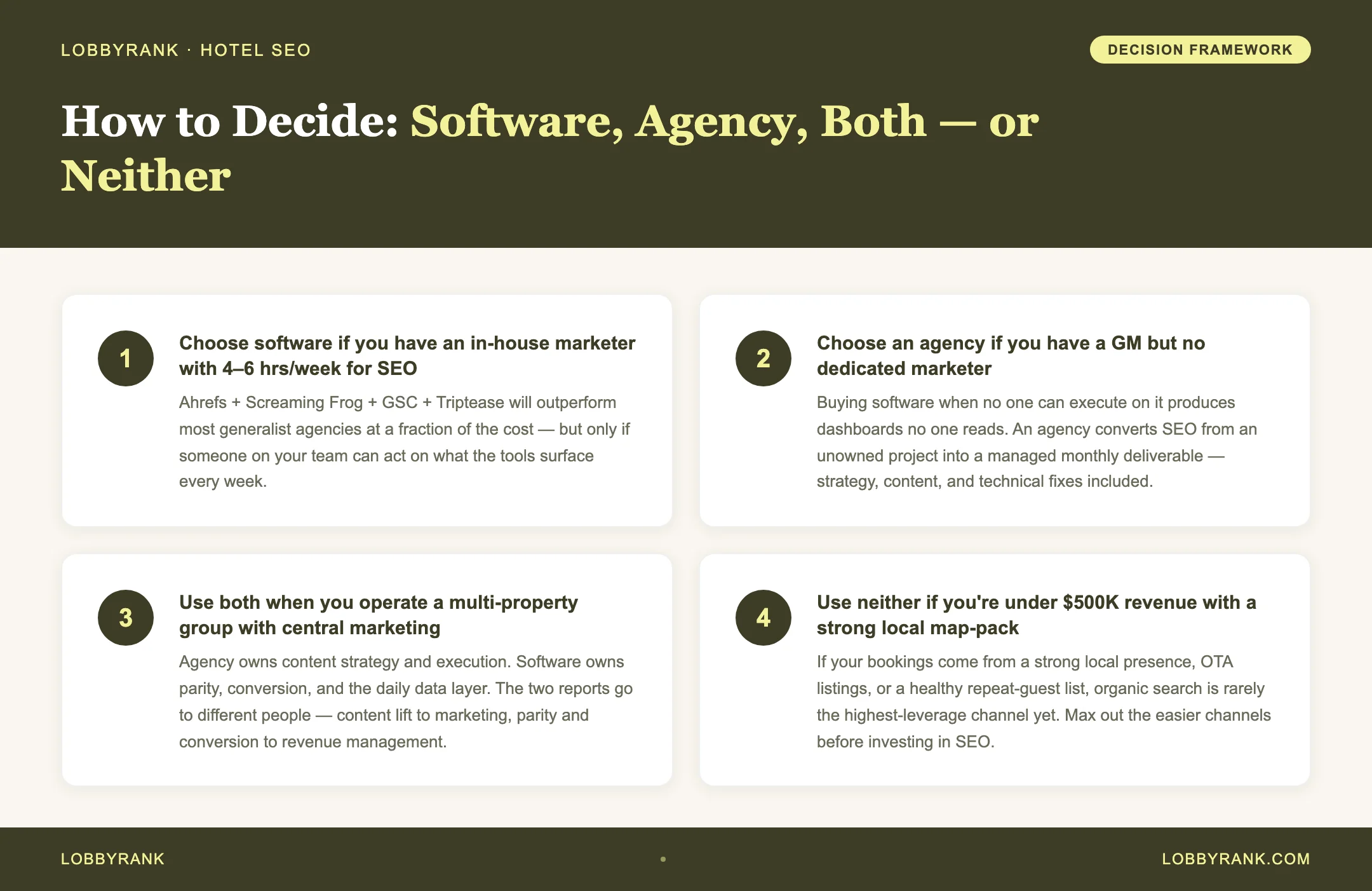
Software wins when: You have an in-house marketing manager (or a strong revenue manager with marketing instincts) who can spend at least 4-6 hours a week on SEO. You have someone who can write content, or budget to commission it freelance. You want full ownership of the data and the workflow. In this case, a stack like Ahrefs + Screaming Frog + GSC + Triptease will outperform most generalist agencies for a fraction of the cost.
Agency wins when: You have a GM and a revenue manager but no marketer. Or you have a marketer whose time is fully consumed by paid campaigns, social, and OTA content. Buying software in this situation produces dashboards no one reads. An agency converts SEO from an unowned project into a managed line item with monthly deliverables. This is the case for most independent groups in the 1-12 property range.
You need both when: You operate a multi-property group with central marketing. The agency owns content strategy and execution; software owns parity, conversion, and the daily data layer. The two reports go to different people internally — content lift goes to the marketing lead, conversion and parity goes to the revenue manager. Budget runs $1,500 to $8,000 a month for the agency plus $500 to $3,000 for the software stack.
You need neither when: You operate one property under $500K in annual room revenue, and your bookings come almost entirely from a strong local map-pack presence, OTA listings, or a healthy repeat-guest list. Organic search is real work for a real ROI window. If the easier channels are not maxed out yet, do those first. We have told prospects this on intro calls and we will keep doing it. SEO is not the right first lever for every hotel.
Where LobbyRank Fits — Honestly
We are an agency, not a software platform. We sit in the automation-first specialist tier described above, at $750/month for established hotel websites and $1,200/month for new domains. We use the same general SEO tools any agency does (Ahrefs, GSC, Screaming Frog), plus hotel-specific data sources. The work is content, technical fixes, and strategy. You can read the full scope on our hotel SEO consulting page.
We are the right fit for one shape of hotel: independent or small-chain, 1 to 12 properties, frustrated by OTA commission economics, and either without an in-house marketer or with a marketer who is already at capacity. If that does not describe you, the section above is more useful than our homepage is.
If you are still deciding, the best next step is usually not to talk to us. It is to spend an afternoon in Google Search Console looking at which keywords already send you traffic, and an hour in Ahrefs or SEMrush mapping the gap to your three closest competitors. That exercise tells you whether you have a content problem, a technical problem, or a conversion problem — and which of the four cases above you are actually in.
Direct bookings start with search. Whether you build that with software, an agency, or both is a budget and bandwidth question, not a brand-loyalty one.

Camilla Gleditsch has led marketing and communications across Asia and Europe for 11+ years, including regional agency communications at BBDO across nine markets. She now runs a portfolio of specialized SEO businesses, each serving a single vertical with deep expertise and full-service infrastructure.