Hotels Spent Two Years Optimising For The Wrong Schema. Hotel and LodgingBusiness Was The Real Win

Most independent hotels and small chains we audit have FAQ schema enabled on their direct-booking pages and no Hotel or LodgingBusiness schema configured at all. That backwards allocation made some sense in 2022. After Google retired FAQ rich results in August 2023, it stopped making sense. Most properties never updated.
What changed
Google narrowed FAQ rich result eligibility in August 2023 to authoritative government and medical institution sites only. Commercial hospitality (independent hotels, boutique chains, even branded properties) lost the FAQ dropdown in standard SERPs. Search Engine Land reported the rollout and confirmed no exception for travel or hospitality.
The hospitality sector has a quirk that made the loss more frustrating than for most niches. Hotels had access all along to a richer, hospitality-specific schema family: Hotel and LodgingBusiness. It produces dramatically more SERP real estate than FAQ schema ever did. Star ratings, room counts, amenities lists, location maps, price ranges, check-in times. None of which were ever in the FAQ rich result toolkit. And almost no property we audit has the hospitality schema configured.
Why FAQ schema took over hotel direct-booking pages
In our experience auditing independent and small-chain hotels, the migration was driven by two pressures:
1. OTA dominance in hospitality SERPs. A search like “boutique hotel Lisbon city centre” returns Booking.com, Expedia, Hotels.com, TripAdvisor, and Google’s own hotel pack at positions 1-7. A direct-booking page sits at position 9 or 10 if it ranks at all. FAQ rich results were one of the only SERP features small properties could use to expand their listing’s vertical footprint and reclaim a click that would otherwise route through an OTA’s commission funnel.
2. Hotel schema requires a developer. Setting up Hotel or LodgingBusiness schema correctly means populating room-type entities, amenity arrays, geo-coordinates, check-in policy fields, and pricing arrays, all in JSON-LD that has to validate against Google’s hospitality structured-data guidelines. FAQ schema was a single Yoast block on a WordPress site. The path of least engineering resistance won, even though the long-term ROI was upside-down.
We covered the OTA-vs-direct-booking dynamic in the hotel SEO checklist for direct bookings. Schema misallocation is one of the recurring patterns.
What independent hotels should do now
1. Configure Hotel or LodgingBusiness schema on the homepage and every room-type page
This is the move that compounds hardest for a small property. Done correctly, it earns:
- Star rating display on branded SERP results
- Price range in the result snippet
- Amenities chip-list in some queries (pool, spa, parking, pet-friendly)
- Geo-coordinate display in local SERPs
- Check-in policy snippet for last-minute booking queries
- Eligibility for richer treatment in Google’s hotel pack on branded searches
The configuration is per-property. A 12-room boutique needs a Hotel entity; a 4-cabin glamping site uses LodgingBusiness with a lodgingType of “VacationRental.” The taxonomy matters. Google rejects schema that mismatches the property type.
| Schema | What it earns in 2026 | Hotel use case |
|---|---|---|
| Hotel | Star ratings, amenities, price range, hotel pack eligibility | Traditional hotels, boutique properties |
| LodgingBusiness | Same features plus more flexible property types | B&B, glamping, vacation rental, hostels |
| Organization | Knowledge Panel on branded search | Sitewide |
| BreadcrumbList | Clean SERP path | All pages |
| LocalBusiness | Local pack eligibility, hours, address | If the brand has a single physical location |
| FAQPage | AEO citation only, no SERP visibility | Keep, stop investing more |
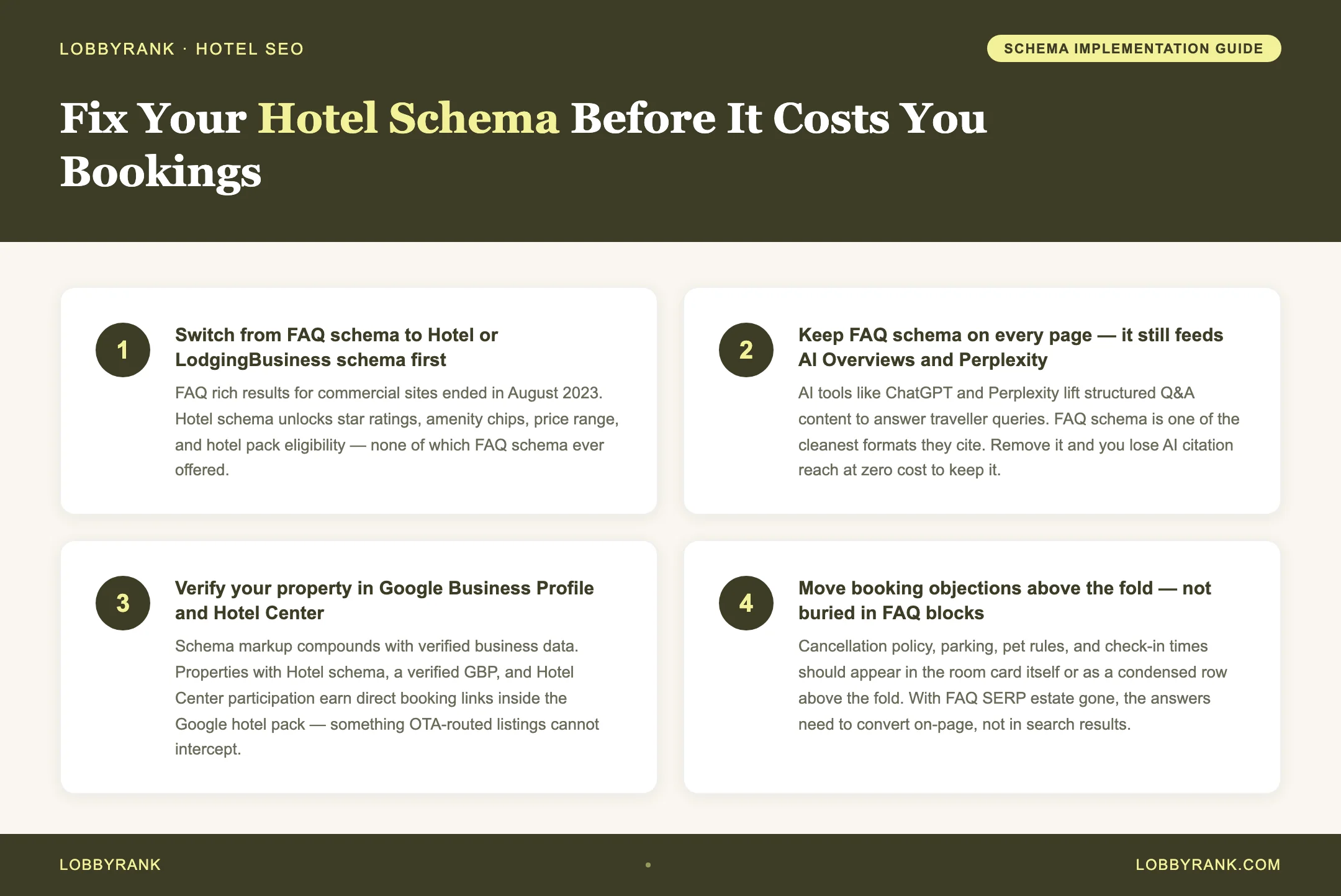
2. Move objection-handling content out of FAQ blocks and into the booking-decision flow
The reason FAQ blocks worked on hotel direct-booking pages was that they answered the questions that pushed a buyer to abandon for an OTA: cancellation policy, check-in time, parking, pet rules, breakfast inclusion. With the SERP estate gone, the answers still need to be visible. Just not buried in an FAQ section at the bottom of the page.
The structural pattern that converts in 2026:
- Top three booking objections rendered as room-card subheadings, next to the price
- Cancellation policy in the room card itself, not behind a click
- A condensed amenities row above the fold on the homepage
- The full FAQ block kept at the bottom for AEO citation purposes
3. Verify the property is in Google Business Profile and Hotel Center
Schema markup compounds with verified business data. A property with Hotel schema, a verified Google Business Profile, and Hotel Center participation earns a different SERP treatment than a property with schema alone. The verification is free, takes about a week, and unlocks features like booking links directly in the Google hotel pack, something OTA-routed traffic cannot intercept.
If your hotel direct-booking strategy is still leaning on FAQ schema for SERP visibility, the schema rebuild is where to start. We work through the full architecture in the LobbyRank pillar guide on hotel SEO, and there is a deeper post on SEO website design specifically for hotels covering the page-structure side.
If your property wants this work done (full Hotel schema configuration, GBP and Hotel Center verification, direct-booking page restructure), it is the first thing LobbyRank ships in the first month of every engagement.
FAQ
Should we remove FAQ schema from our hotel website? Travellers now vet properties through ChatGPT, Perplexity, and AI Overviews well before they ever land on a Google SERP, and FAQ schema is one of the cleanest formats those engines lift answers from. Keeping it intercepts the buyer earlier in the booking funnel than it used to, at zero cost. Leave it on. Just stop treating it as a SERP play.
Does Google’s exception apply to wellness retreats or medical-spa hotels? No. The exception is for authoritative medical institution sites only: hospitals, peer-reviewed sources, gov health agencies. A commercial wellness retreat or medical-spa property does not qualify regardless of the medical content offered on-site.
Why does Hotel schema matter more than LocalBusiness for hotels? LocalBusiness is generic. Hotel and LodgingBusiness are hospitality-specific and unlock features generic LocalBusiness schema does not: star ratings, room counts, amenity arrays, hotel pack eligibility. A property using LocalBusiness schema is leaving most of the SERP feature set on the table.

Camilla Gleditsch has led marketing and communications across Asia and Europe for 11+ years, including regional agency communications at BBDO across nine markets. She now runs a portfolio of specialized SEO businesses, each serving a single vertical with deep expertise and full-service infrastructure.