SEO Website Design for Hotels: What Actually Matters

A hotel website can be visually stunning and still rank on page three. Design choices made for aesthetic reasons, without consideration for how Google evaluates pages, regularly cost hotels their direct booking traffic.
This is not about choosing between a beautiful site and one that ranks. It is about understanding which design decisions affect search performance, and making sure the visual choices are not quietly sabotaging the SEO.
Why Design Matters for Hotel SEO

Google does not rank websites on aesthetics. It ranks on performance signals: how fast the page loads, whether it works on mobile, whether the content is structured so search engines understand it, and whether users find what they need quickly.
OTA platforms are optimized relentlessly for these signals. They have hundreds of engineers working on page speed, mobile experience, and crawlability. A hotel website with a five-second load time and a complex booking engine that Google cannot crawl is competing with a machine-optimized platform. The machine wins.
The gap is not inevitable. Hotel websites that address the structural SEO issues built into most hospitality web designs can close it. The starting point is understanding exactly which design decisions create those issues.
Core Web Vitals: The Speed Baseline
Google measures three performance signals on every page, grouped under Core Web Vitals:
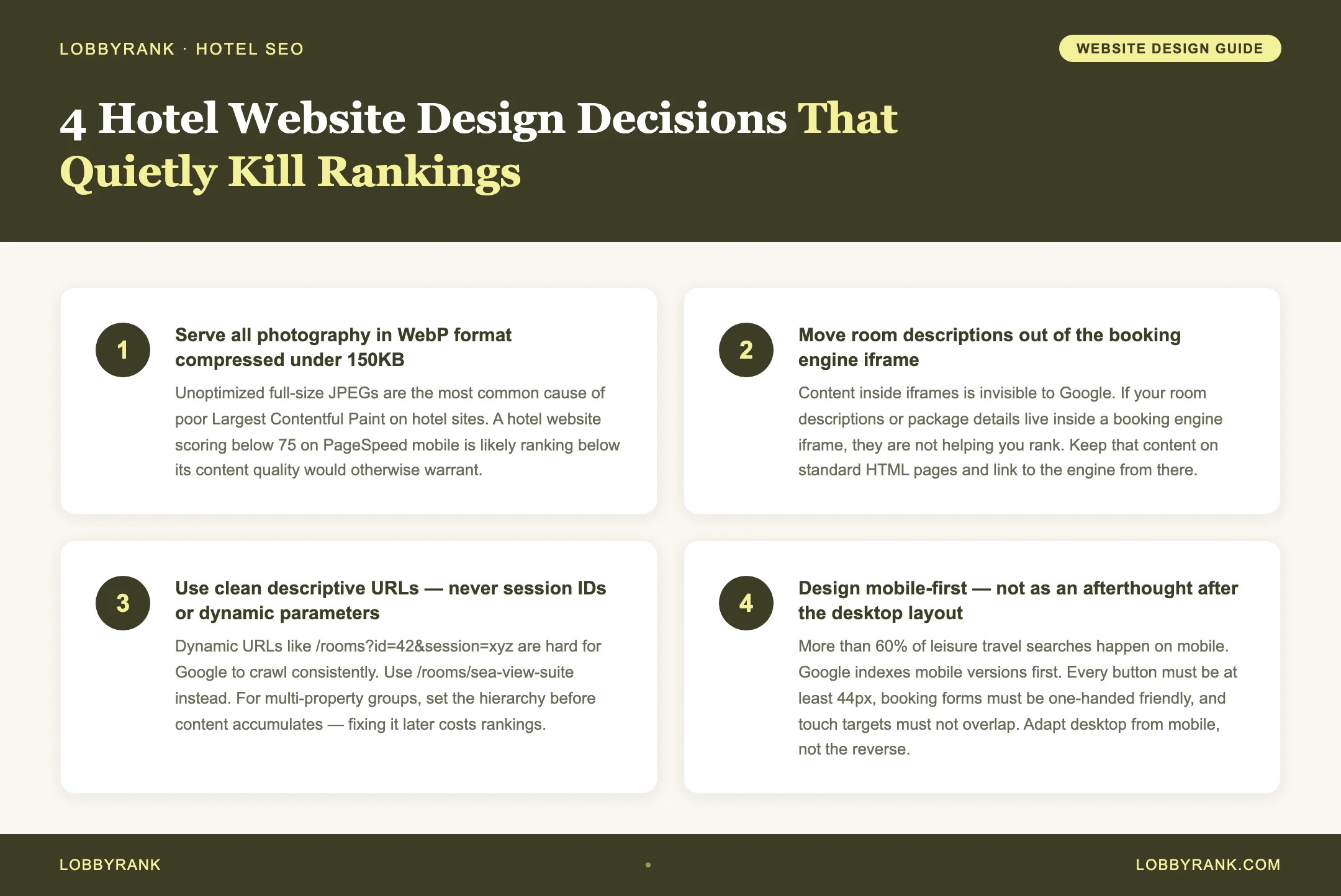
Largest Contentful Paint (LCP): How long it takes for the main content of a page to appear. For hotels, this is usually a hero image or a photography-heavy header. Unoptimized photography (full-size JPEGs above 1MB) is the most common cause of poor LCP on hotel websites.
Interaction to Next Paint (INP): How quickly the page responds when a user clicks or taps something. Heavy JavaScript from third-party booking widgets is the most common cause of poor INP.
Cumulative Layout Shift (CLS): How much the page layout shifts as it loads. Fonts, images without specified dimensions, and dynamically loaded content that pushes other content around are the usual causes.
A hotel website that scores below 75 on Google’s PageSpeed Insights for mobile is likely ranking below its content quality would otherwise warrant. This is the first thing to fix.
Practical fixes:
- Serve all photography in WebP or AVIF format, not JPEG or PNG
- Compress hero images to under 150KB without visible quality loss
- Specify image dimensions in HTML so the browser allocates space before images load
- Load third-party booking scripts asynchronously so they do not block page rendering
- Use a content delivery network (CDN) so assets load from servers close to the user
Mobile-First Design Is Not Optional
More than 60% of leisure travel searches happen on mobile. Google indexes mobile versions of pages first. A hotel website that delivers a degraded mobile experience is being evaluated by Google on its worst performance.
Common mobile design failures on hotel websites:
- Navigation menus that are difficult to use on small screens
- Text that requires horizontal scrolling or zooming to read
- Booking forms with input fields that are too small to tap accurately
- Hero images that crop badly at mobile aspect ratios, removing key visual information
- Touch targets (buttons, links) smaller than 44px, which increases accidental clicks and exit rates
Mobile-first hotel website design means designing the mobile experience before the desktop experience, not adapting a desktop layout after the fact. Every component, every button size, every font size should be specified for mobile first, with desktop as the enhancement.
URL Structure for Multi-Property Hotels
Hotels with multiple properties, room types, or packages frequently create URL structures that work against their own SEO.
Common problems:
- Dynamic URLs with session IDs or tracking parameters:
hotel.com/rooms?id=42&session=xyz. Google struggles to crawl and index these consistently. - Duplicate content across similar room pages with no canonical tags indicating which version should rank.
- Seasonal pages created at
/special-offersduring peak season and then deleted, creating broken links and losing any ranking signals those pages had accumulated.
What works:
- Clean, descriptive URLs:
/rooms/sea-view-suitenot/room?id=042 - Permanent URLs for seasonal content with updated dates rather than deleted and re-created pages
- Canonical tags on room variants (king/twin configurations of the same room category)
- A clear hierarchy:
/properties/[property-name]/rooms/[room-name]for multi-property groups
For a hotel group with three properties, getting the URL structure right before launching is significantly easier than fixing it after content has accumulated. The SEO cost of a bad URL structure compounds over time.
Schema Markup: Structured Data for Hotels
Schema markup tells Google precisely what a page is about, in a format it can process without interpretation. For hotels, this is not optional if you want to appear in rich search results.
The core schema types for hotel websites:
Hotel schema: Name, address, price range, amenities, check-in and check-out times, number of rooms, star rating. This feeds directly into Google’s hotel search panels.
FAQPage schema: Answers to the questions your guests ask most frequently. “Is breakfast included?” “Do you allow dogs?” “What is the cancellation policy?” Pages with FAQPage schema often appear with expandable FAQ sections in search results, increasing click-through rates.
Review and AggregateRating schema: If you display guest reviews on your own website (not just on Tripadvisor or Google), marking them up with schema allows Google to show your star rating in search results.
BreadcrumbList schema: Helps Google understand your site hierarchy and displays navigational breadcrumbs in search results for multi-property or multi-page sites.
Schema markup does not directly improve your ranking position, but it improves how your listing appears in search results. A result with a star rating and FAQ expansion gets more clicks than a plain blue link, all else equal.
Booking Engine SEO Considerations
Most hotel websites embed a third-party booking engine. This creates two recurring SEO problems.
Problem one: The booking engine loads in an iframe. Content in iframes is not indexed by Google as part of your page. If your room descriptions, package details, or pricing information lives inside a booking engine iframe, Google cannot see it. That content does not help you rank.
Solution: Keep all important content (room descriptions, package details, amenity lists) on standard HTML pages that Google can crawl. Link to the booking engine from those pages rather than embedding room information inside it.
Problem two: The booking engine creates URL parameters that generate duplicate content. When guests select dates, the URL changes (/rooms?checkin=2026-04-15&checkout=2026-04-18). Google treats each variation as a separate page, potentially indexing hundreds of duplicate room pages.
Solution: Use the canonical tag on booking engine pages to point back to the canonical room page. Work with your booking engine provider to set this up. Most major providers support it.
Putting It Together: Design Choices That Affect Rankings
| Design element | SEO impact | Fix |
|---|---|---|
| Large uncompressed photography | Slow LCP, poor Core Web Vitals | WebP format, compress to under 150KB |
| Third-party booking widget JavaScript | Slow INP, blocked rendering | Load async, defer non-critical scripts |
| Dynamic URLs from booking engine | Duplicate content, indexation issues | Canonical tags, clean URL structure |
| No schema markup | No rich results from Hotel/LodgingBusiness schema, no AI Overview citation eligibility, lower CTR | Implement Hotel/LodgingBusiness schema for rich results, plus FAQPage schema for AI Overview citations (Google retired FAQ blue-link rich results in 2023, but the schema still feeds AI search) |
| Mobile-unfriendly layout | Google mobile-first index penalizes | Redesign mobile-first |
| Room content inside booking engine iframe | Google cannot index it | Move content to standard HTML pages |
The Relationship Between Design and Direct Bookings
A hotel website that ranks well on Google for the right searches and then converts that traffic to direct bookings is the goal. Design affects both sides of that equation.
Speed and mobile performance determine whether Google ranks the page. Information architecture, schema markup, and content structure determine whether the right guests find it. Clear calls to action and a frictionless booking engine determine whether they book direct rather than clicking back to an OTA.
LobbyRank addresses all three in every engagement. The technical audit at the start of a retainer identifies the design-related issues affecting your rankings. The content strategy builds the pages that rank. The AEO optimization ensures your properties appear when travellers use AI search tools.
For the technical SEO elements specifically, see our technical SEO for hotels service page. And for a broader view of how all the SEO layers fit together, the hotel SEO company guide is the place to start.

Camilla Gleditsch has led marketing and communications across Asia and Europe for 11+ years, including regional agency communications at BBDO across nine markets. She now runs a portfolio of specialized SEO businesses, each serving a single vertical with deep expertise and full-service infrastructure.