Best SEO Tools for Hotels in 2026

The best SEO tools for hotels are the ones that surface the right information for hospitality-specific decisions. Keyword difficulty scores, seasonal search trends, technical audit reports, and rank tracking for the experience-led searches that drive direct bookings.
This guide covers eight tools organized by what they actually do. Each one is evaluated through a single lens: does it help a hotel or hotel group rank higher on Google and improve its direct booking ratio?
Keyword Research Tools

1. Ahrefs ($129/month — Lite plan)
Ahrefs is the standard keyword research tool for hotel SEO. Its keyword explorer is particularly good for the long-tail experience searches that resorts and boutique hotels need to target.
What it does for hotels: You can search terms like “spa hotel Yorkshire” and see exact monthly search volume, keyword difficulty, and the sites currently ranking. The “Matching terms” and “Related terms” reports surface the full universe of searches guests use, many of which your competitors have never considered.
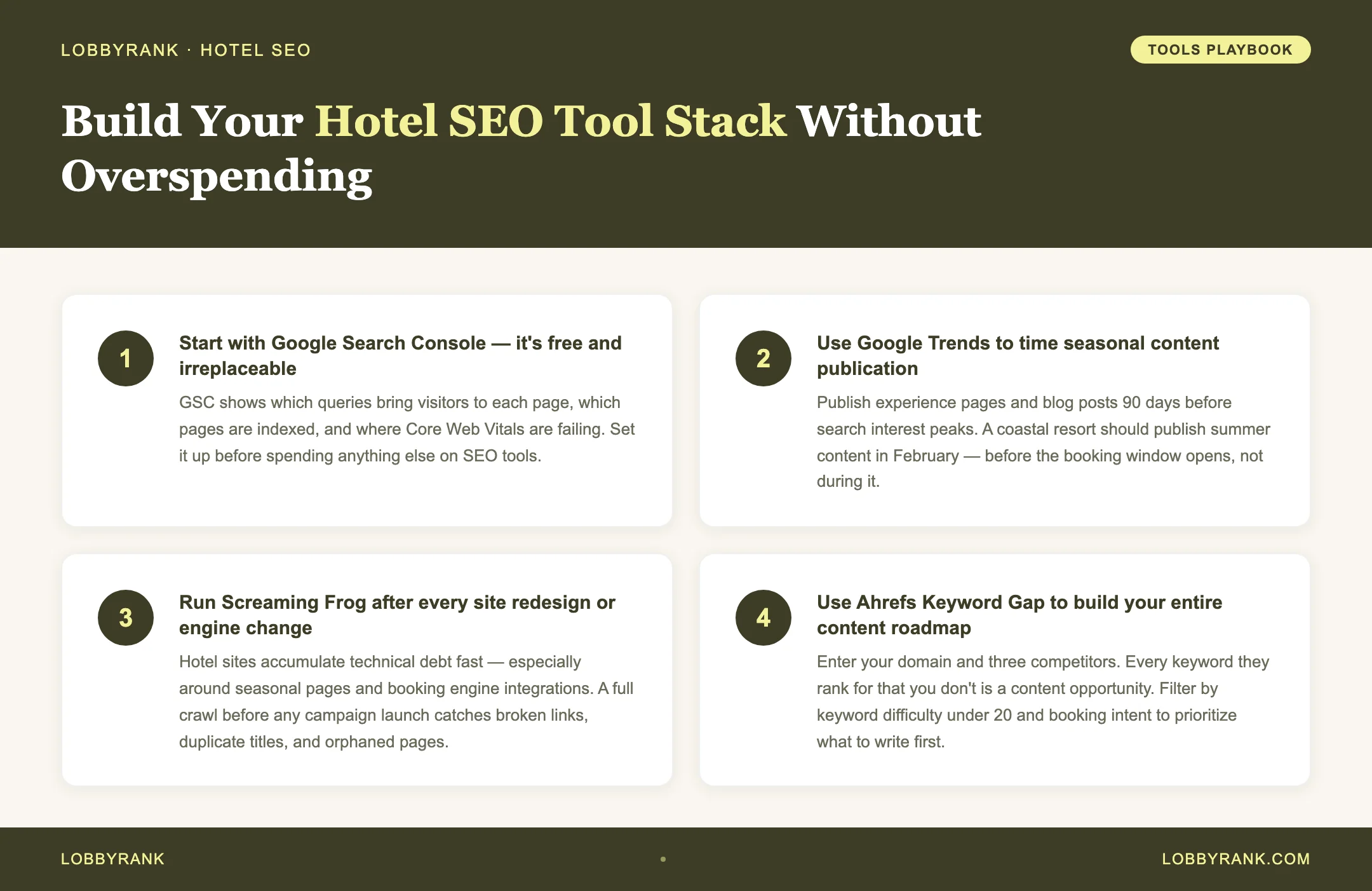
Best use: Competitive gap analysis. Enter your hotel group’s domain and three competitors. The Keyword Gap report shows every keyword they rank for that you do not. That list is your content roadmap.
ADR relevance: Ahrefs lets you filter by search intent. Transactional and commercial keywords (the ones that drive bookings at full ADR rather than bargain searches) are identifiable with a few filters.
Verdict: The strongest tool for hotel keyword research. Use it to plan your content strategy and track competitor rankings.
2. Google Trends (Free)
Google Trends shows search interest over time. For hotels, it is the most underused free tool available.
What it does for hotels: It reveals seasonality patterns for every destination and experience type. A coastal resort in the UK can see exactly when searches for “summer sea view hotel Cornwall” start to spike (typically February and March for summer bookings) and time content publishing accordingly.
Best use: Seasonal content planning. Publish experience pages and blog posts 90 days before search interest peaks so they have time to rank before the booking window opens.
RevPAR relevance: Publishing content ahead of peak intent windows means ranking when guests are actively choosing where to spend their highest-value stays. That is a RevPAR lever, not just an SEO tactic.
Verdict: Free, fast, and directly useful for hotel content timing. Run it before planning every quarter’s content calendar.
Technical Audit Tools
3. Google Search Console (Free)
Every hotel website needs Google Search Console set up before anything else. It is the only tool that shows you exactly how Google sees your site.
What it does for hotels: Shows which search queries bring visitors to each page, which pages are indexed, which have mobile usability issues, and which Core Web Vitals problems Google has flagged. It also shows manual penalties if your site has ever been affected.
Best use: Weekly check of the Coverage and Core Web Vitals reports. Both identify indexation and performance issues before they affect rankings.
Direct booking relevance: The Performance report shows which queries bring visitors who then reach your booking page. That data tells you which content is driving booking intent specifically, not just traffic.
Verdict: Essential. Free. Set it up before spending a pound on anything else.
4. Screaming Frog SEO Spider (Free up to 500 URLs / £199/year)
Screaming Frog crawls your website the way Google does. It finds every technical issue that might be preventing your pages from ranking.
What it does for hotels: Finds broken links, missing or duplicate title tags, pages blocked from crawling, slow-loading images, redirect chains, missing alt text on photography, and orphaned pages that no internal links point to.
Best use: Run a full crawl before launching any new campaign or after a site redesign. Hotel websites accumulate technical debt quickly, particularly around seasonal pages and booking engine integrations.
OTA counter-strategy relevance: OTA sites are technically near-perfect. They have engineering teams dedicated to crawlability. If your hotel website has even moderate technical issues, you are giving OTAs an advantage they did not earn through content quality.
Verdict: Essential for technical audits. The free version is sufficient for hotels with under 500 pages.
5. PageSpeed Insights (Free)
Google’s own tool for measuring Core Web Vitals. Free, immediate, and directly relevant to how Google evaluates your pages.
What it does for hotels: Gives a mobile and desktop performance score (0 to 100) and itemizes exactly which elements are slowing your pages down. For hotel websites, the culprits are almost always uncompressed photography, third-party booking engine scripts, and web fonts loading in render-blocking ways.
Best use: Run it on your homepage, your top three room pages, and your contact page. These are the pages guests visit most before booking. If any score below 70 on mobile, fix the identified issues before doing anything else.
Verdict: Free. Should be checked monthly and after every design change.
Rank Tracking
6. SEMrush ($139/month — Pro plan)
SEMrush covers keyword research, site auditing, and rank tracking in one platform. Its rank tracking is particularly useful for hotels managing visibility across multiple locations or property types.
What it does for hotels: The Position Tracking tool monitors your rankings for a defined keyword set across specific locations. For a hotel group with properties in Edinburgh, York, and Bath, you can track rankings in each city separately. The Site Audit tool covers similar ground to Screaming Frog but runs in the cloud without needing to install software.
Best use: Ongoing rank tracking for your target keyword universe. See which pages are moving up, which are dropping, and where content investment is paying off in ranking terms.
Verdict: The best all-in-one option if you want keyword research, technical audit, and rank tracking without managing multiple tools. Worth it if your monthly SEO investment justifies a platform.
Content Optimization
7. Surfer SEO ($99/month — Essential plan)
Surfer SEO analyses the top-ranking pages for any keyword and tells you what your page needs to compete.
What it does for hotels: When you are writing a page for “adults-only resort Lake District,” Surfer analyses the pages currently ranking for that term and tells you the expected word count, which related phrases appear in the top results, how many headings those pages use, and what your content is missing.
Best use: Content brief creation. Before writing any hotel experience page or blog post, run the target keyword through Surfer to understand what the top-ranking pages contain. Write to that standard, then add the hospitality-specific expertise that generic pages lack.
Verdict: Useful for content quality. Not essential if you have an experienced SEO writer who understands hospitality search intent. Valuable if you are producing content at volume and need a systematic quality check.
Schema and AEO
8. Schema Markup Validator (Free — via Google and Schema.org)
Google’s Rich Results Test and the Schema.org validator check whether the structured data on your hotel pages is correctly implemented.
What it does for hotels: Validates Hotel schema, FAQPage schema, and Review schema so they display correctly in search results. A schema implementation error can prevent rich results from appearing even when the markup is present.
Best use: After implementing or updating any schema markup. Run both the Google Rich Results Test (tests rich result eligibility) and the Schema.org validator (catches formatting errors) before publishing.
AEO relevance: FAQPage schema feeds directly into Google’s AI Overviews and voice search answers. Hotels with correctly implemented FAQ schema on experience pages can appear in AI search responses when travellers ask where to stay in a particular area.
Verdict: Free, fast, and necessary any time you touch schema markup.
Tools vs. an SEO Agency
Tools provide data. They cannot interpret that data in the context of hotel operations, OTA commission dynamics, seasonal demand patterns, or RevPAR targets.
Screaming Frog will tell you that 47 pages have missing title tags. It will not tell you which pages, if ranking well, would most improve your direct booking ratio. Ahrefs will show you a list of keywords your competitors rank for. It will not build the content cluster that captures them.
An SEO agency with hospitality expertise does both. The tools are the data layer. The strategy, content production, and execution are what move rankings and improve the metrics hotel groups actually track: direct booking ratio, ADR on organic traffic, OTA commission reduction.
LobbyRank includes all the tools listed here in a single retainer. You do not need to manage separate subscriptions or interpret data without hospitality context. We track the keywords that matter, fix the technical issues, produce the content, and report on the metrics that connect to room revenue.
For a full overview of how hotel SEO works from the ground up, read our hotel SEO company guide. If you want to talk through your property’s current search visibility, see our hotel SEO consulting page.

Camilla Gleditsch has led marketing and communications across Asia and Europe for 11+ years, including regional agency communications at BBDO across nine markets. She now runs a portfolio of specialized SEO businesses, each serving a single vertical with deep expertise and full-service infrastructure.